
SC26 in Chicago was a week of the HPC community coming together, and the High Performance Software Foundation (HPSF) was right at the center of it. Across tutorials, workshops, papers, posters, birds-of-a-feather sessions, panels and a presence in the exhibit hall, HPSF projects and the people who lead them were central to the conversation. The HPSF is a neutral home where projects, member organizations and users work on shared challenges in HPC such as portable performance, reproducible software, containers, system management and AI-ready software ecosystems, instead of each solving them alone. Here are our key takeaways from our participation at this year’s SC26.
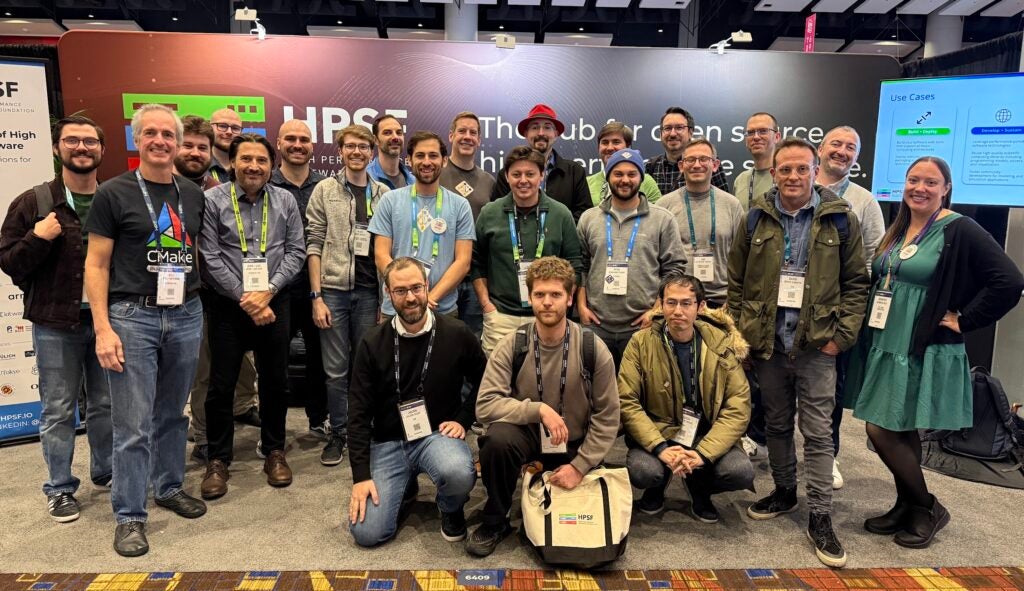
The community gathered at the HPSF booth
The HPSF booth (#6409) in the exhibit hall was a meeting point for anyone interested in high performance software. Attendees could talk directly with technical representatives of projects including Spack, Kokkos, Chapel, Charliecloud, E4S, Environment Modules, ClusterShell, and more ask about the latest developments, and see how the projects fit together. HPSF’s role is to support projects that advance portable software for diverse hardware by increasing adoption, aiding community growth and enabling development efforts, with the goal of lowering barriers to productive use of today’s and future HPC systems. Face-to-face conversations at the booth featured good discussions with everyone who stopped by.
A community win: Spack takes the HPCwire Readers’ Choice Award
HPCwire announced its 23rd annual Readers’ and Editors’ Choice Awards at SC26. In Best HPC/AI Programming Tool or Technology, the Readers’ Choice Award went to HPSF Project, Spack. Readers’ Choice winners are voted on by HPCwire’s worldwide audience of end users, so this award reflects how many people depend on Spack day to day, and it is a win for the community around it: the maintainers, contributors, sites and HPSF members who build and support it.
Core projects
Spack
Spack is HPSF’s package manager for supercomputers, Linux and macOS, and it showed up across the week in several ways.
Managing HPC Software Complexity with Spack (full-day tutorial). The hands-on tutorial was built for end users who install packages, developers who write their own, and facility staff who deploy software for many users. Recent editions walk through basics, environments and configuration, then software stacks, packaging, developer workflows, mirrors and binary caches, and scripting.
LLMs as Packagers of HPC Software (workshop talk). This talk looks at a pressing scaling problem: Spack has more than 8,500 packages, each defined by a recipe, and creating and maintaining recipes is labor-intensive, especially for newcomers. The associated paper from Lawrence Livermore National Laboratory researchers introduces SpackIt, which combines repository analysis, retrieval of similar examples and iterative repair from diagnostic feedback. On 308 open-source HPC packages, it raised installation success from 20% in a zero-shot setting to over 80% in its best configuration.
Spack User Group Happy Hour. Sponsored by Susquehanna, this fun evening event brought the Spack team together with users, developers and contributors for food, drinks, networking and swag. It was the community side of the project in one room, and a natural place to celebrate the award.
Kokkos
Kokkos, HPSF’s C++ performance portability ecosystem, had a large presence at SC this year.
Kokkos: Performance Portability for C++ Applications and Libraries (full-day tutorial). A beginner-oriented introduction to writing hardware-agnostic C++ with Kokkos. The morning covers why Kokkos exists, basic data-parallel patterns and building applications, then memory layouts, advanced reductions and tightly nested loops with MDRangePolicy. The afternoon covers subviews, View assignment rules and wrapping external allocations with unmanaged Views. Attendees did hands-on exercises on cloud instances sponsored by NVIDIA (NVIDIA Brev), and no CUDA, HIP or SYCL background was needed.
Performance Improvement of Multi-Dimensional Parallel Loops in Kokkos. Work on speeding up multi-dimensional parallel loops, the same area the tutorial teaches through MDRangePolicy. It shows the community improving the core of the programming model itself.
Energy-Aware Performance Characterization of Kokkos Kernels Across Precision Levels. Measures energy use and performance of Kokkos Kernels, the math library layer of the Kokkos ecosystem, across numerical precisions, a timely question as energy and mixed precision become central to HPC and AI systems.
Correctness Evidence for I/O Optimizations in VPIC-Kokkos: Preliminary Results. A work-in-progress talk on showing that I/O optimizations remain correct in VPIC-Kokkos, a particle-in-cell application built on Kokkos, illustrating how production science codes rely on the ecosystem.
A Performance-Portable GPU-Accelerated Solution for the Particle-Particle Particle-Mesh Method using Cabana and FFTX. A solver built on Cabana (a particle toolkit that builds on Kokkos) and FFTX, demonstrating Kokkos as a base layer for other libraries.
Kokkos also helps shape the language itself: its team members have contributed to the ISO C++ committee, and features such as std::atomic_ref and std::mdspan in recent C++ standards echo capabilities Kokkos pioneered.
Established projects
Apptainer
Overlay Containers in Apptainer. A talk on overlay containers in Apptainer, the project (formerly Singularity) that packages software components for portability and reproducibility. It sits alongside the week’s other container sessions and shows HPSF’s container projects tackling practical, day-to-day HPC needs.
Chapel
Chapel is HPSF’s programming language for productive parallel computing, from desktops to supercomputers. Two talks showed it being tested against real hardware and real competition.
The Price of a Single Source: Performance Portability of Chapel and Julia across CPUs and GPUs. Compares Chapel and Julia to ask what performance a single-source program keeps or gives up across CPUs and GPUs, a direct evaluation of Chapel’s portability promise.
Porting and Benchmarking Chapel on Emerging RISC-V Hardware: An HPC Viability Study. Asks whether Chapel is viable on emerging RISC-V processors, extending the project’s reach to new architectures and supporting HPSF’s focus on diverse hardware.
Charliecloud
Charliecloud provides user-defined software stacks for HPC centers, and its sessions focused on AI.
Benchmarking Agentic AI Workflows with Charliecloud. Measures how agentic AI workflows perform when run in Charliecloud containers, relevant as centers look for ways to run new AI workloads on existing HPC systems.
Charliecloud: Image Build Optimization for AI Workloads. Looks at making container image builds faster for AI workloads, which often depend on large and complex software stacks.
Flux Framework
Flux Framework is HPSF’s resource management and scheduling framework, spanning workloads from containers to the world’s largest systems.
Flux: Workload Management for HPC and AI/ML Simulation in the Cloud (half-day tutorial). An introduction to Flux’s fully hierarchical resource management and graph-based scheduling, which suit workflows that couple simulation with AI/ML across HPC and cloud environments.
Workload-Manager-Agnostic QPU Integration with QRMI (tutorial, with a Flux Framework demo). A hands-on tutorial on connecting quantum processors to HPC through QRMI, a vendor-neutral interface that connects processors from vendors such as IBM, Pasqal and Alice & Bob to schedulers including Slurm, PBS, IBM LSF, Open Cluster Scheduler, Kubernetes and Flux.
HPX
A Locality-Aware Execution Model for Distributed Graph Algorithms using NWGraph and HPX. Pairs the NWGraph library with HPX, HPSF’s asynchronous many-task runtime, to keep distributed graph computation close to its data. It shows HPX serving as a foundation for irregular, data-intensive workloads.
Trilinos
Scalable AMG Preconditioning for DG Neutron Diffusion Solvers on Manycore CPUs. Algebraic multigrid preconditioning for discontinuous Galerkin neutron diffusion solvers, a topic closely tied to the scalable linear solvers Trilinos is known for, and an example of solver libraries enabling nuclear energy simulation on modern CPUs.
WarpX
Stress-Testing Exascale Scientific Data Output: ADIOS2 Configuration Strategies for WarpX under Extreme Load Imbalance. Explores how ADIOS2 settings hold up when WarpX, HPSF’s electromagnetic and electrostatic particle-in-cell code, writes data under severe load imbalance at exascale.
More projects at the booth
ClusterShell (parallel command execution and node group management for clusters) and Environment Modules (dynamic shell environment management) were also represented at the HPSF booth, giving visitors a information on how to utilize these projects.
Emerging projects
E4S
E4S is HPSF’s HPC-AI software ecosystem for science, and it showed up at SC.
E4S: An HPC-AI Software Ecosystem for Science (workshop talk). An overview of how E4S curates and integrates HPC and AI packages, using Spack to build and test them for compatibility, portability and reproducibility.
CI for E4S: Build and Test Automation for a Containerized HPC-AI Software Stack (workshop talk). Explains the continuous integration that keeps the stack healthy.
Using Containers to Accelerate HPC (full-day tutorial). A hands-on tutorial on running containers on HPC systems.
E4S 26.11 release. During the week, E4S announced release 26.11 with more than 125 HPC and AI packages built on Spack 1.3, container images for Ubuntu 24.04 and Rocky Linux 9.8, an Apache Guacamole remote desktop for browser access to graphical tools such as ParaView and VisIt, expanded agentic-AI tools, and the NCCL, NIXL and NVSHMEM GPU communication runtimes.
OpenCHAMI
OpenCHAMI is HPSF’s system management platform that brings cloud-like flexibility and security to HPC.
OpenCHAMI for Deployment of Inference Services. Applies OpenCHAMI’s microservices-based, containerized approach to deploying AI inference on HPC systems.
Scalable OpenCHAMI Node Infrastructure Collection (SONIC) (poster). Shows how node infrastructure data can be collected at scale with OpenCHAMI.
OpenCHAMI Community Birds of a Feather. An open forum for users and developers to share experience and shape the project’s direction, community building in its most direct form.
Designing Open, Heterogeneous System Monitoring Around OpenCHAMI (Birds of a Feather). A community discussion of open monitoring for systems that mix CPUs, GPUs and other accelerators.
Ramble
Reproducible Benchmarking for High-Performance Computing Applications (tutorial). A hands-on tutorial on benchmarking HPC applications so others can repeat and verify the results. This is closely aligned with Ramble, HPSF’s experimentation framework focused on capturing provenance and improving reproducibility.
Viskores
Viskores is HPSF’s toolkit of scientific visualization algorithms for emerging processor architectures, and the poster session featured visualization work on the same theme.
A Viskores-Enhanced Vision Transformer Framework for MRI-Based Cancer Image Classification on Frontier. A poster combining Viskores with a vision transformer for medical image classification on the Frontier supercomputer, a clear case of the toolkit supporting AI-driven science.
Correlation-Aware Uncertainty Visualization of Multivariate Data with Many-Core Acceleration. A poster on visualizing uncertainty in multivariate data using many-core hardware, in the same area of scalable visualization.
Conversations across the whole community
Some of the most important sessions were about how projects work together rather than any single project.
Containers and software stacks. The talk The case for unprivileged containerization in HPC, or: Does software simplicity still matter in 2026? argued for running containers without elevated privileges and asked whether simplicity should still guide HPC software design, a question central to HPSF’s container projects. The poster Union of Containers: Layered Software Stacks with Cross-Container Dependency Reuse for HPC explores reusing dependencies across container layers.
Portability and programming models. 14 GPU Programming Paradigms Put to the Test: Performance Portability and Halstead Difficulty in Scientific Computing compared fourteen GPU programming approaches on both performance portability and code complexity. Platform-Agnostic Kernel Fusion Pipeline for Linear Algebra Kernels in MLIR explored fusing kernels without tying them to one platform, Performance-Portable Exact Gaussian Process Regression in Python via SYCL and oneMath brought portable performance to Python, and Interactive Debugger for Performance Portable Python HPC Kernels tackled debugging them. The OpenACC Forum looked at the future of programming accelerators with directives. Together they speak directly to HPSF’s mission of portable software for diverse hardware.
AI and the future of HPC software. The birds-of-a-feather session The Impact of GenAI on HPC Programming and Programming Models asked how generative AI is changing the way HPC code is written, a conversation echoed by the Spack packaging work above. Descriptive Execution of HPC Applications and Workflows explored describing, rather than hand-scripting, how applications and workflows run.
Sovereign, secure infrastructure. Building a Kubernetes-first, sovereign HPC system: OpenCUBE described a European Commission-funded, open-source cloud and HPC software stack designed for European hardware, built on Kubernetes and designed to be energy-aware. Security and Day-2 Resilience as First Class Control Plane Primitives for Heterogeneous Supercomputers argued that security and ongoing resilience belong in the control plane from the start. Both connect to the same questions HPSF projects such as OpenCHAMI address.
Software for large applications and graph analytics. The session Software for Large Scale Application looked at the software practices behind large-scale codes, and the poster Subgraph Counting: Methods, Frameworks, and Applications surveyed methods and frameworks for a core graph analytics problem.
People. The panel The Future of the HPC Workforce: Skills, Scale, and Sustainability addressed the skills the community needs and how to grow and sustain that workforce, the same people-first principle behind HPSF’s work and community programs.
Better together
What stood out at SC26 was how connected the pieces are. Spack builds the software that E4S packages; Kokkos underpins applications and libraries; Flux and OpenCHAMI manage the systems that run them; Chapel, HPX, Charliecloud and Apptainer give developers and centers more ways to build and deploy; and Ramble and Viskores help scientists reproduce and understand their results. HPSF gives these projects a common, neutral home, and the activities at SC last week are evidence of what that community can do together. Thank you to everyone who presented, staffed the booth, visited the booth, and joined in the conversation.
Ready to join the HPSF community and want share your work? Submit a proposal for the HPSF Conference (HPSFCon) 2027, taking place April 12–16 in Montreal. The call for proposals is open until January 17, 2027: submit your talk now.